Find information on how to make a Protected Disclosure under the external procedures in place in the HEA.
Find information on how to make a Protected Disclosure under the external procedures in place in the HEA.
INSPIRE is a €750 million investment package that will address research infrastructure needs across the higher education sector while ensuring alignment with national research and innovation priorities.
Tracking graduate outcomes is crucial to improving the quality of education for students and outcomes for graduates.
By James Holohan
Posted: 19 November, 2026
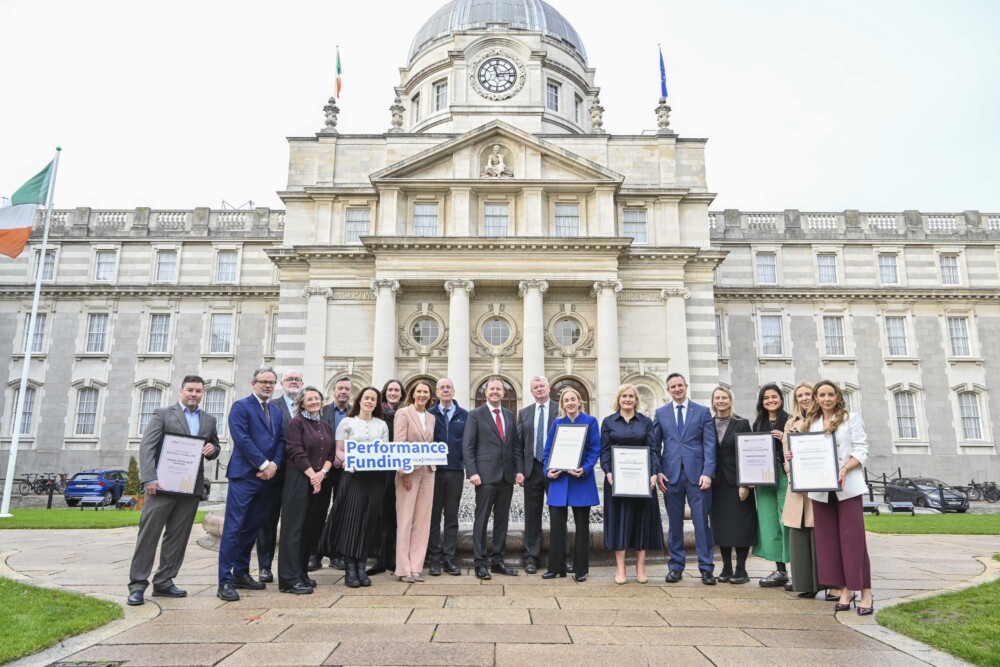
Minister for Further and Higher Education, Research, Innovation and Science, James Lawless, T.D., has announced today the allocation of performance funding awards totalling €5 million to five higher education institutions. Atlantic Technological University, Maynooth University, University College Dublin, University of Galway and the University of Limerick are each being awarded €1 million in recognition of exemplary initiatives that have delivered impact in areas of national strategic priority.
Minister Lawless, commenting on today’s awards, stated:
“I would like to congratulate the five institutions receiving this year’s performance funding awards. These projects show the real difference that higher education and research can make in people’s lives and communities.
From supporting children and families, widening access to STEM education and improving care for older adults, to empowering communities to take climate action and creating innovative learning experiences, each initiative is delivering tangible benefits.
These initiatives highlight the important role our higher education sector plays in improving lives, strengthening communities and addressing some of the key challenges facing society today.”
Performance funding is awarded on the basis of an evaluation of Impact Assessment Case Studies submitted by higher education institutions (HEIs) to the Higher Education Authority (HEA).
HEIs were invited to outline an initiative that has made a significant contribution to the achievement of national strategy and provide an assessment of its impact. The case studies were evaluated by an independent expert panel.
Dr Alan Wall, CEO of the HEA, commented:
“These awards showcase five diverse and valuable initiatives across the higher education and research sector. Each makes a unique contribution to the achievement of national priorities across health, the environment and society. All the initiatives are collaborative in nature and are firmly embedded in communities and wider networks nationally and further afield. The HEA is pleased to support this work, highlight its value and share learnings with the sector as they emerge.”
Among the successful initiatives is Atlantic Technological University’s Sustainable Energy Communities (SEC) mentoring programme. Through structured mentoring and support, this collaborative initiative – involving Local Authorities and Development Companies, Údarás na Gaeltachta, social enterprises and cross-border organisations – is helping communities to build knowledge and capacity, while empowering communities to develop and deliver local climate action projects, strengthening regional sustainability and resilience.
Maynooth University’s STEM Passport for Inclusion is addressing inequalities in access to Science, Technology, Engineering and Mathematics (STEM), with a particular focus on girls attending Delivering Equality of Opportunity in Schools (DEIS) schools. The programme connects schools, universities, industry and government partners to deliver university-accredited learning, industry mentoring, work-placement opportunities and facilitated pathways to expand participation in higher education for underrepresented communities across the island of Ireland and create a more diverse future STEM workforce.
University College Dublin’s Preparing for Life (PFL) programme, developed by the Northside Partnership, is Europe’s longest-running parenting programme, providing structured parenting support from pregnancy to age five in socioeconomically disadvantaged Dublin communities. Backed by a long-term evaluation that follows parents and children to age 14, it demonstrates that early investment in families improves life outcomes and can help break the intergenerational cycle of poverty.
University of Galway’s Empathy Studio, Ireland’s first purpose-built immersive empathy learning environment, reframes empathy as a capability that can be purposely developed rather than a personal trait. The Empathy Studio enables students, professionals and organisations to better understand the lived experience of others through simulation, soundscapes, virtual reality and structured reflection, and to use those insights to improve decision making, service design and professional practice.
University of Limerick’s Ageing Research Centre (ARC), in collaboration with policy makers, clinical and academic colleagues, undertook research to improve the delivery of emergency healthcare to older adults. The research, co-designed by older adults, demonstrated how early assessment and intervention by a dedicated team of Health and Social Care Professionals (HSCPs) can improve the quality, safety and efficiency of care for older adults attending Emergency Departments while reducing pressure on hospital services, with its uptake in policy supporting health service reform.
Performance funding was first introduced under the HEA’s 2018–2020 System Performance Framework to support and recognise positive performance in Ireland’s higher education and research system. Today’s announcement brings the total awarded to date, to recognise exemplary performance in the higher education system, to €35m, supporting over 50 projects aligned with national strategic objectives.
Further information on successful case studies is published on the ‘Institutional Stories of Impact’ page on the HEA’s website.
Table 1. Performance Funding Awards 2026
| HEI | Impact Assessment Case Study Title | Award |
| Atlantic Technological University | Community Energy Mentoring for Regional Climate Action and Resilience | €1m |
| Maynooth University | STEM Passport for Inclusion: Transforming STEM access for disadvantaged students | €1m |
| University College Dublin | Preparing for Life: changing children’s lives through early parenting support | €1m |
| University of Galway | Empathy to Innovation: Impact from Ireland’s First Immersive Empathy Studio | €1m |
| University of Limerick | Changing how emergency healthcare is delivered to older adults | €1m |
| Total | €5m |
The System Performance Framework 2023–2028 sets out parameters under which designated higher education institutions identify their contribution to the achievement of national strategy, as appropriate to their mission, scale, location, and strategic plan.
HEIs’ annual reporting requirements under the System Performance Framework 2023–2028 include the submission of an Impact Assessment Case Study (IACS). Impact Assessment Case Studies are linked to a positive funding mechanism that supports and recognises excellent performance within the higher education and research system.
Performance funding was first introduced in 2019, and today’s announcement brings the total Performance funding awarded to date to HEIs to €35 million. Impacts and learnings from successful case studies are highlighted in ‘Institutional Stories of Impact’ on the HEA website.
Under the System Performance Framework 2023–2028, the IACS process provides institutions with an opportunity to demonstrate their significant contributions towards the achievement of national strategy by describing the design, delivery, and outcomes of an exemplary initiative and providing an assessment of its impact.
The purpose of IACS is to:
Performance funding can be used to expand and progress existing initiatives or put towards new initiatives that contribute towards national strategic objectives. Project plans and budgets are agreed with the HEA to support progress monitoring and evaluation of outcomes over the lifetime of funded projects.
Queries can be directed to systemperformance@hea.ie.